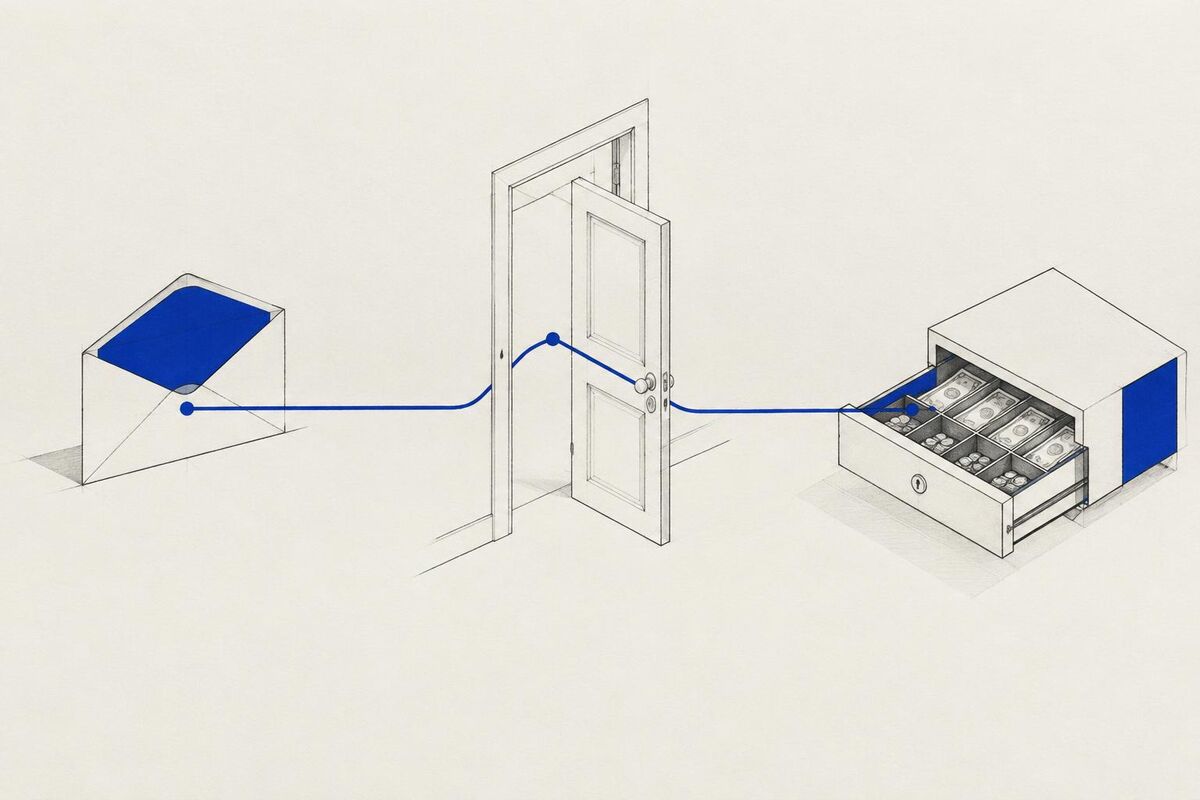
A customer on a train pays a deposit for a rehearsal space. The bank approves the charge. Just as the booking site starts to load its confirmation page, the train enters a tunnel. What does the studio think has happened?
This is a real design problem. Stripe describes precisely this failure in its guidance for merchants. A payment can succeed even if the buyer never reaches the final page. In an automated booking flow, an event from the payment provider can tell the merchant what happened. The integration must also handle receiving the same event more than once without fulfilling the order twice. A customer who has paid deserves one room, one receipt and a way to retrieve both. 1
A business can buy another thousand visits while that fault is still there. It can also install an elaborate CRM and leave the same customer standing outside. Conversion work starts by agreeing what counts as a completed sale and following one person far enough to see it happen.
Draw the journey with the people who do the work
For this guide, take an imaginary studio that hires rehearsal rooms by the session. Its weekly calendar looks busy, but the owner suspects some enquiries disappear between Instagram, email and the evening shift. Sit down with the person who answers those messages, the person who handles deposits and the person who unlocks the doors. Give them one recent completed booking and one that went quiet. Remove personal details from the exercise. Ask each colleague to reconstruct what they saw.
Write down the first enquiry, where it went, who replied, which evidence confirmed availability, what the customer was asked to do and how someone knew the room was paid for. Keep exceptions in the picture. A repeat band may book in person. Two bandmates may message separately about the same evening. A touring manager may be paying on behalf of a musician. A journey that assumes one person, one device and one conversation will have difficulty with all three.
At this point choose the unit you intend to count. For the studio it could be a distinct request for a room on specified dates. One band emailing and then calling about the same session makes one enquiry. A returning band asking for another date makes a new one. Someone asking for directions to a confirmed booking is an existing customer needing help. Give the team examples so they can tell the difference.
Build a pipeline a newcomer could operate
A customer relationship management system, or CRM, is the shared place where the team can find a relationship and its next action. Use a record for the booking opportunity and associate the people involved with it. A single regular customer can produce several bookings. If the software treats the word “customer” as the end of every journey, a repeat sale can be hard to see.
HubSpot, for example, documents separate pipelines for leads and deals and permits custom stages. A deal stage can carry a probability used to calculate a weighted amount. That amount depends on the chosen probability. A band still owes its deposit even when a dashboard assigns a generous chance of closing. 2
| Stage for the studio | Evidence that moves the booking forward | Role that acts next |
|---|---|---|
| New enquiry | A request with enough information to give a useful first answer | Duty coordinator |
| Suitable session | Customer need and a genuinely available session match | Booking coordinator |
| Offer sent | Customer has the current quote, terms and the exact date a hold expires | Named owner of the booking |
| Confirmed | Agreed confirmation condition met and the calendar reflects it | Studio host |
| Completed or cancelled | Attendance or cancellation recorded, with refund status where relevant | Operations or finance |
Allow an enquiry to be closed as unsuitable, lost or declined, with a reason when known. A studio at capacity has a different problem from a studio whose prices are surprising buyers. Keep a time for the next action while a booking remains open. A named colleague needs to see and cover that commitment when the owner is away.
Write the reply a customer can act on
A good first reply to an unspecified enquiry may be a question. “Which Saturday, how many musicians and do you need a drum kit?” is a useful response if each answer changes availability. For a request that already contains all three, the same reply makes the buyer repeat work.
Draft the normal reply for a specific session. It should identify the room and date, what the fee includes, whether the room is being held, what confirms it and a route to a person. Send an automatic acknowledgment only with information the system knows. “We have received your request for Saturday” is safe when receipt is recorded. “Your studio is booked” requires something much stronger.
Write the less comfortable replies too. What happens when two buyers want the last slot? Who can extend a hold? Can a deposit be transferred to a different date? Put the answer beside the action in the system. A promise stored in a training deck can be difficult to find at nine on a Friday evening. Give staff discretion over matters they can actually resolve and one quick route to a person who can decide exceptions.
Make booking easy to finish, including when a customer makes a mistake
Open the form on an ordinary phone. Try using it with a keyboard alone. Enter an invalid date. Go back to correct it. Does the page explain what went wrong? Did it preserve everything else? W3C's guidance on identifying input errors calls for telling people which item has a problem and describing the error in text. A red outline by itself leaves people guessing. 3
Before payment, show the booking details that could cause a costly mistake, including date, local time, room, duration, amount payable now and any balance due later. Let the buyer change an answer without starting again. After the transaction, give a reference, what happens next, where to get help and a record they can return to. These ideas appear in the UK Government Design System's patterns for checking answers and confirming transactions. The published patterns were built for public services. A studio can borrow the parts that help someone arrive at the right door. 4
Talk to the person at the desk about payments still processing, expired holds, duplicate notifications and money received for a slot that is no longer available. For each one, assign a real state and a person or process that can resolve it. Make a test booking in the payment provider's test environment. Close the tab immediately after authorisation, let the confirmation arrive twice and cancel the booking. At the end, the payment record, diary and customer message should agree. 1
Work out where the loss is before repairing it
Suppose that over a fully observed month the studio records 120 distinct enquiries, 90 suitable requests, 60 written offers, 24 paid reservations and 20 attended sessions. Assume the appointments have all passed by the reporting date. The conversion from enquiry to paid booking is 24 divided by 120, or 20%. From offer to paid booking it is 24 divided by 60, or 40%. Four confirmed sessions did not take place. Saying that 40% of enquiries booked would give the owner twice the actual figure.
| Trace one month's bookings | A question the figures can support |
|---|---|
| 30 enquiries never became suitable requests | Were the dates full, was the room unsuitable or did the team never obtain enough information? |
| 30 suitable requests received no written offer | Did staff lose the thread, did customers withdraw or was an alternative agreed by phone? |
| 36 written offers did not become paid bookings | Open several records with permission. Look for timing, price, an expired link or a missing answer |
| Four paid reservations did not attend | Check cancellations, refunds, reminders and how to find the entrance |
Those counts locate the work. They do not by themselves reveal the cause. Open a small sample from the largest group. If several buyers clicked an expired link after a quote had been extended, reproduce the fault and correct it before refining the follow up copy. Put a date on the change and compare later bookings that have had the same time to mature. An enquiry received yesterday has had fewer opportunities to close than one received six weeks ago.
Give the owner a ten minute Friday routine
Choose one paid booking, one lost enquiry and the oldest open request. Read the actual exchange alongside the dashboard. Can the owner tell what the customer was promised? Is their next question answered? Can finance match the deposit? If one of the three cannot be explained, give it to a named person before the weekend. Clear any follow up when someone pays, declines or asks to stop hearing from the business. The most carefully written reminder will still be unwelcome after a customer has already settled the bill.
A Conversion Mission suits a specific build, such as fixing the route from enquiry to deposit or setting up the CRM and handover. A monthly Conversion mandate suits a team that needs someone to keep testing the journey as offers, people and customer behaviour change. RFUD's service page describes both. The acceptance test for the studio is simple enough to run on the owner's own phone. Book a room, interrupt the final screen and ask the person on the next shift what to expect when the band arrives. 5