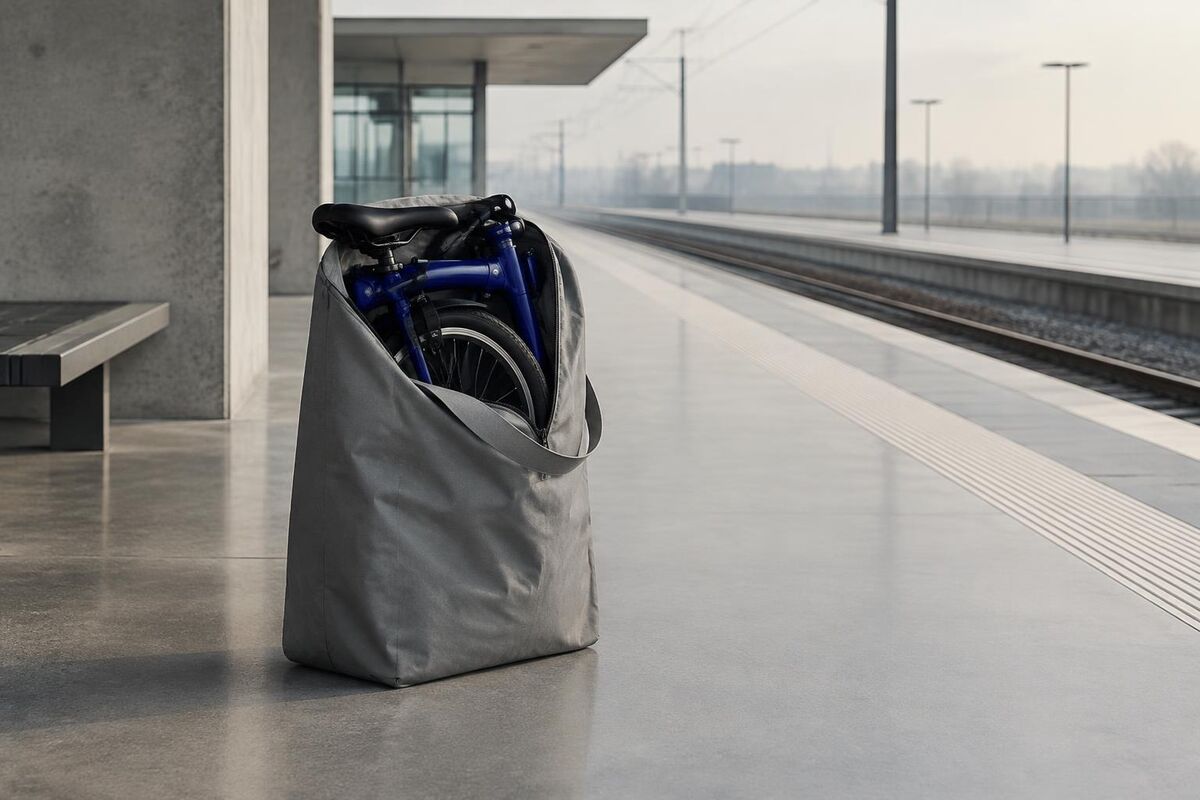
A folding bicycle either fits on the train or it doesn’t. You might think a search engine could settle the matter in a sentence. On Eurostar services to and from London, the limit for a folding bike is 85 cm in length and the passenger needs a bag that closes around the whole bike. Eurostar lists a different allowance of 75 by 53 by 30 cm on its continental routes. Brompton lists the folded size of its four speed C Line as 58.5 by 56.5 by 27 cm. The middle measurement is already 3.5 cm over the continental allowance for standard luggage, before adding a bag. Someone taking that train needs to check the operator’s separate bicycle arrangements. [1]2
For a bike shop, there are several ways this search could end well. The rider might buy a suitable bag, rule out an unsuitable model, or remember the shop that explained why the route mattered. Only some of those things require a visit to its website. From behind the counter, they are quite different outcomes. From inside a website traffic report, two of them can look like nothing at all.
What happens after an answer appears
Pew Research Center examined browsing records from 900 adults in the United States. Across 68,879 distinct Google searches made in March 2025, users followed a conventional result on 8% of visits to pages with an AI summary and on 15% of visits to pages without one. A link inside the summary was the next destination on just 1% of visits where a summary appeared. 3
There is a wrinkle in that last figure. The researchers used the participants’ actual browsing histories, then ran their queries again in April to reconstruct what the results pages looked like. They could match the next visit against up to three links inside each summary. The percentages describe behaviour in one panel during one month. People also use different language for a question about luggage and a search for a shop by name. Pew’s comparison alone cannot tell a particular shop how many visits the summary cost it. 3
In March 2026, a separate research team changed the search experience itself. Stephanie Wang and colleagues randomly assigned US participants to use ordinary Google, a version designed to hide AI Overviews and divert searches away from AI Mode, or one that routinely sent searches to AI Mode. Among 1,100 participants who searched during the experimental week, assignment to AI Mode reduced the rate of clicking through to external sites by 18.8 percentage points compared with ordinary Google. The team reported the result in an August preprint. It was a week of largely enforced use by people who usually searched with Chrome. Someone choosing AI Mode to work through a complicated purchase is a different proposition. 4
Both studies followed clicks. Neither followed the cyclist as far as the till.
What the shop can see
Google made one part of this puzzle easier in 2026. It announced dedicated Search Console reports in June and says the rollout reached sites worldwide on 31 August. The Search report counts occasions when a link to the site was shown in AI Overviews or AI Mode. A site with too few impressions may have no report. An owner can examine pages, countries, devices and dates. The dedicated report gives impressions. An unlinked mention, an individual’s entire conversation and the sale of a bike bag are all outside that measure. 5
Bing exposes a different view of discovery. Its AI Performance report records citations across supported Microsoft experiences and selected partners. In October it introduced a beta view that groups the phrases its systems use to retrieve sources into topics, where the site has enough activity. Those phrases can tell a retailer which subjects lead to its pages. They are machine retrieval phrases, so printing them in a deck as the customer’s verbatim questions would be a mistake. Google impressions and Bing citations belong on separate lines. [6]7
Start the retailer’s report with three questions. Which pages surfaced in answers? Which pages brought someone into the shop’s website through search? Which pages led to a product enquiry, a booking for a test ride or an order? Keep each count beside its own definition. Dividing sales by AI impressions would imply a connection between two populations the shop cannot match. Even when both go up in a holiday month, the timetable and the season deserve a look.
Give the buyer a reason to come through
Suppose a shop has time to make one page before the summer timetable changes. It could write a general guide to travelling with a bike. Or a member of staff could take the bags the shop actually sells, pack the bikes it stocks and measure each packed combination. Publish the model, the date, the dimensions and a photograph showing where the tape went. Link directly to the rules for each relevant route. A rack or an accessory that changes the fit deserves a line of its own. Anyone can repeat the operator’s allowance. Only someone with those bikes and bags can do this particular piece of work.
A rider who gets enough from the summary should be free to leave with the right answer. The rider who follows the link has good reasons to stay. They can see the packed bike, choose a bag or ask the shop to test a model that is missing. Google’s own guidance supports publishing material grounded in the author’s experience. It says its search systems ignore special AI text files such as llms.txt and need no special markup for a page to appear in generative search. That statement applies to Google. 8
Four weeks later, open the reports alongside the enquiries the staff actually received. If riders repeatedly ask whether the bag closes over the handlebars, the next edit is another photograph. If a page attracts attention but sends everyone to a product that is out of stock, give the buyer a route to an available one. And if prospective customers begin asking for a model the shop has never carried, someone buying inventory should see those messages.
The most interesting outcome of the exercise may be a buying decision by the shop itself. No search platform will record that for the owner.