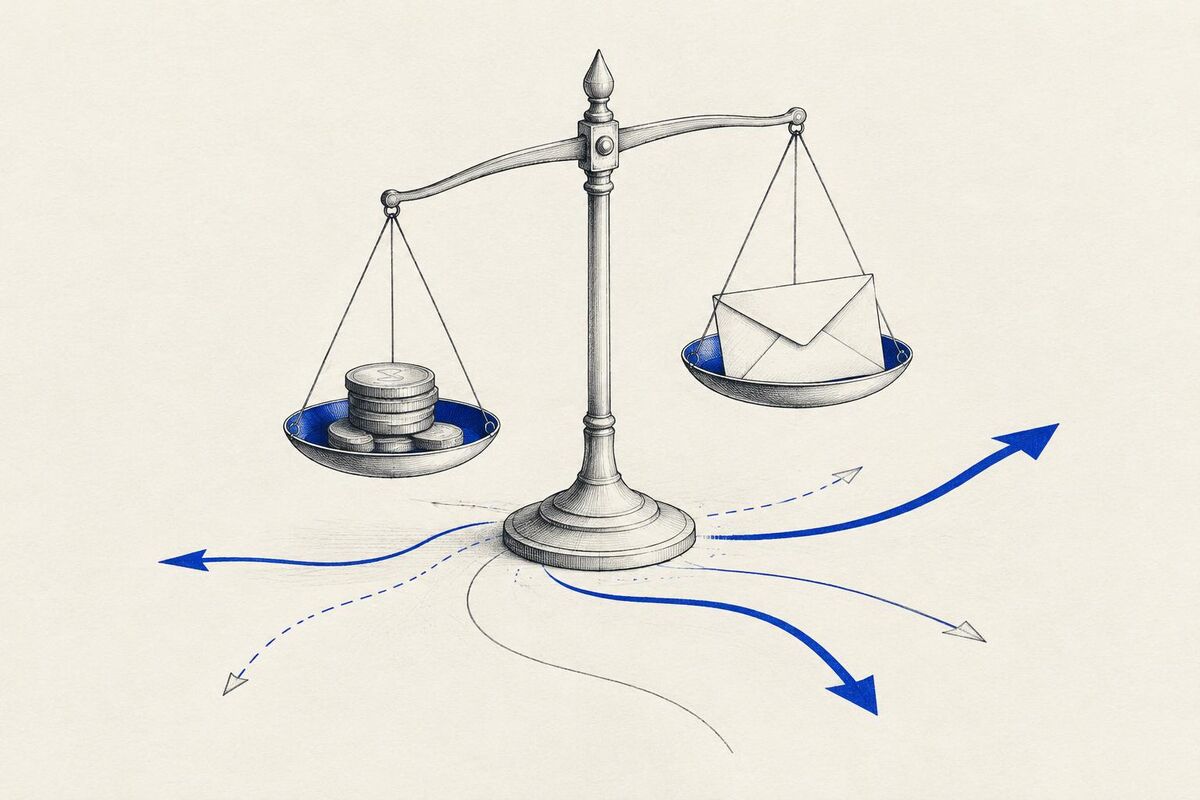
Imagine a cookery school with sixteen unsold places next month. The owner can fill three evenings with bookings and still lose money on the campaign that brought them in. The first line of the brief, “Get more bookings”, leaves out the cost of delivering each reservation. As soon as somebody pays, ingredients, instructor time and payment fees enter the picture. If Friday was likely to sell out anyway, a new booking might also displace a customer who would have paid without seeing an ad.
Sit with the person who runs the classes. Ask which sessions they actually want to fill. Tuesday afternoon is an entirely different brief from Friday night. That one question can change the audience, the offer, the images and the economics of every ticket sold.
Set the price of learning
Here is a worked example for a fictional school. A seat sells for $100 and costs $45 in additional ingredients, labour and transaction charges. It contributes $55 before marketing and fixed overhead. The owner wants to retain at least $15 of that amount, leaving a maximum of $40 to acquire an additional occupied seat. Use an average net ticket price after the discounts and refunds you realistically expect. If there is a material cost to opening an extra session, put that expense in the calculation too.
Assume the school can sell sixteen genuinely additional seats. At $40 each the total acquisition allowance is $640. A $240 creator fee leaves $400 for media, production and any other campaign expense. Assume the school needs no additional production for this example. Filling sixteen seats would yield $1,600 in revenue and $880 in contribution before acquisition. Spend the $640 allowance and $240 remains. Sell eight extra seats on the same spend and contribution after acquisition becomes a loss of $200. Those calculations deliberately give no value to an unknown future booking.
This is the point to ask whether paid acquisition fits. If the all in cost of a professional campaign exceeds the contribution available from sixteen places, a hotel partner who can refer the right guests may be the better deal. A higher value group booking may support more spend, provided someone has checked the likelihood and capacity to deliver it. RFUD quotes its campaign fee separately from media spend. If you hire a partner, include both figures when deciding whether your business can afford the plan. 1
Choose the route by asking what the buyer already knows
A guest typing the name of a school into Search may already have decided to book. A guest searching for activities on a rainy afternoon is still comparing uses of their time. Somebody who follows a local chef might never have considered a class until they see what they would make. Reach, creative and measurement should differ across those three situations.
In a 2026 field study, Jeffrey Larson and Jeffrey Dotson examined prospecting and retargeting on Google and Facebook for a mattress seller. In that setting, ads aimed at reaching prospective customers produced better returns than ads aimed at previous visitors. The experiment concerns a durable product sold by one advertiser. It gives an owner a good reason to test the costly assumption that the warmest audience always deserves the most money. It does not supply a budget ratio for a cooking school. 2
Choose one plausible starting channel and name its weakness. Search may catch explicit demand but miss guests who have no idea the experience exists. A hotel newsletter might provide the right audience but reach people after they have filled their itinerary. A creator may show the experience beautifully while speaking mainly to people overseas. Request examples of recent work and aggregate audience geography where available. Confirm when someone can act on the offer.
Give creative a job
The first image should answer something the buyer cares about. For a nervous beginner, show the instructor helping a guest fold a dumpling. For a group organiser, show the layout with twelve people at work. Write a brief each person on the shoot can read in a minute.
| Brief item | Worked example for the cookery school |
|---|---|
| Audience and moment | Visitors planning a weekday afternoon once they are on the island |
| Promise | Make three dishes in a class that welcomes beginners |
| Evidence | Show the actual dishes, instructor and working stations |
| Action | Choose a Tuesday session with places available |
| Constraint | Show only dietary accommodations the kitchen can reliably provide |
| Commercial test | Additional occupied seats at an all in cost the class can support |
Make two executions that differ in one meaningful way, such as the instructor demonstrating the technique versus guests eating what they made. Use the same offer and availability where you want to compare the creative. If you change the price, audience and weekday together, you can still choose the combination that earns money. You will have a harder time identifying which change did the work.
Buy a collaboration as carefully as an advert
In research published in the Journal of Marketing, Maximilian Beichert and colleagues examined paid Instagram endorsements, including field studies with two direct to consumer firms. Smaller creators delivered stronger returns against endorsement cost in their setting. It is unusually useful evidence because the authors connected posts to revenue and counted costs. It applies to the campaigns studied. Local reputation, timing, language and the right to reuse the material can change which creator is worth hiring. 3
For the school, it may be sensible to pay someone who speaks the language of guests arriving that month and can teach a recognisable technique on camera. Agree on the deliverables, usage rights, costs, timing and disclosure before filming. Ask whether the fee includes paid distribution of the footage. Budget the seat the creator occupies at its real cost, and consider the lost contribution if the session would otherwise sell out. If a paid endorsement reaches US consumers, the FTC's guidance calls for a clear, conspicuous disclosure of a material connection. Check the rules in the markets the campaign will actually reach. 4
Make a booking traceable all the way to the kitchen
Use a distinct landing link for each source, with a shared convention for source, medium and campaign. Google Analytics documents how these parameters identify referring campaigns. Test the links after a booking provider or messaging app opens. Ask one person to go all the way through on a phone. Did the correct class open? Did the price change? Can the booking record carry the source through to attendance? 5
Keep independent totals for money spent, seats booked, seats refunded and guests who attended. If two systems claim the same customer, the school can still cook only one meal for that person. Give each booking one identifier in the operating report. Preserve the two claims as context and count the sale once. A code or tracking link can help identify an order. It cannot tell you if the guest would have booked without the promotion.
Decide what would justify another round
At sufficient scale, a team can assign comparable regions to different advertising conditions and compare what happens. Jon Vaver and Jim Koehler describe geographic experiments designed for this purpose. An island venue whose guests move between towns may have neither enough independent markets nor adequate sales volume. Dividing two adjacent neighbourhoods and calling one a control would lend a fragile comparison a great deal of undeserved authority. 6
For a smaller campaign, assemble the strongest account you can defend. Publish how many eligible seats existed, how many sold, which sales were directly traceable, the full cost and any competing explanations. A quiet baseline week and a holiday test week are worth describing. If refunds arrive later, date the first report and schedule a reconciliation. Agree in advance what evidence would change your next decision. You might stop if the campaign fills only sessions that were already busy. You might rerun it with a different offer if qualified people arrive and cannot find a date.
A campaign Mission fits a defined promotion with a close date and an owner for the result. A monthly Acquisition mandate fits an ongoing need to buy media, commission fresh work and choose the next test. In either arrangement the best report is one the person running the kitchen can challenge. They know exactly how many people came on Tuesday. 1